
Content Cluster Strategy for Long-Term SEO Growth
Introduction
Many businesses publish blog posts regularly but still struggle to get consistent organic traffic. They may write articles based on different keywords, but the content does not always follow a clear structure. As a result, search engines may find it difficult to understand the main topics the website covers.
A content cluster strategy helps solve this problem. It organizes related content around one main topic. This structure usually includes a detailed pillar page, several supporting cluster articles and strategic internal links between them. The main purpose is to cover a topic deeply instead of publishing unrelated posts.
For example, a digital marketing website may choose “SEO” as its main topic. The website can create one detailed pillar page about SEO and support it with articles about keyword research, technical SEO, on-page SEO, link building and local SEO.
When these pages are connected properly, users can easily find more useful information. Search engines can also understand that the website has strong knowledge about the topic.
What Is a Content Cluster?
A content cluster is a group of related web pages that focus on one broad subject. It has three main parts: the pillar page, cluster content and internal links.
The pillar page is the main, detailed guide that explains a broad topic. It gives readers a general understanding of the subject and links to more specific articles.
The cluster content consists of supporting articles. Each article covers one specific subtopic in detail and targets a related long-tail keyword.
Internal linking connects the pillar page with the supporting articles. Cluster articles should link back to the pillar page, while the pillar page should link to the relevant cluster articles.
A simple structure looks like this:
Pillar page: Complete Guide to SEO.
Cluster article: How to Do Keyword Research.
Cluster article: What Is Technical SEO?
Cluster article: On-Page SEO Best Practices.
Cluster article: How to Build Quality Backlinks.
Cluster article: Local SEO for Small Businesses.
This structure allows a website to cover one topic from different angles.
Why Content Clusters Are Important for SEO
Traditional SEO often focuses on creating one article for one keyword. While keywords are still important, search engines now try to understand the complete meaning and context of a topic.
A single article may rank for one or two keywords, but a well-planned content cluster can help a website target many related searches. It can also improve the overall user experience because readers can move from one relevant article to another.
Content clusters can support SEO growth in the following ways:
They help search engines understand your main areas of expertise.
They create a logical website structure.
They improve internal linking.
They help users find more related information.
They target both broad and long-tail keywords.
They can increase time spent on the website.
They create more opportunities for conversions.
A content cluster may not produce results immediately. Its performance usually improves as more useful content is published, connected and updated over time. The goal is to build long-term topical authority instead of expecting instant rankings.
How to Create a Content Cluster Strategy
Choose a Core Topic
The first step is selecting a broad topic that is relevant to your business and useful to your audience. The topic should have enough subtopics to support multiple articles.
For example, an online fitness business may choose “Home Workouts” as its core topic. Possible supporting topics may include beginner exercises, home workout equipment, weight loss workouts, strength training and workout plans.
When choosing a core topic, ask yourself:
Is this topic related to my products or services?
Is my target audience searching for this information?
Can I create several useful articles around this topic?
Can this topic support my business goals?
Avoid choosing a topic only because it has high search volume. The topic should also be relevant to your expertise and business.
Research Keywords and Search Intent
After choosing the core topic, research the keywords and questions connected to it. Do not focus only on high-volume keywords. Long-tail keywords are also important because they are more specific and often show clear user intent.
For example, “content marketing” is a broad keyword. Related long-tail keywords may include:
How to create a content marketing strategy.
Content marketing ideas for small businesses.
How to measure content marketing ROI.
Content marketing tools for beginners.
You should also understand search intent. Search intent means the reason behind a user’s search. Some people want information, some want to compare products and others are ready to make a purchase.
Your content cluster should include articles for different types of search intent:
Informational content for users who want to learn.
Comparison content for users researching options.
Commercial content for users considering a product or service.
Transactional content for users ready to buy.
Create the Pillar Page
The pillar page should provide a complete overview of the main topic. It does not need to answer every question in extreme detail, but it should cover the important subtopics and guide readers to more specific articles.
A good pillar page usually includes an introduction, key concepts, practical steps, examples, common mistakes and links to supporting content.
For example, a pillar page titled “Complete Guide to Email Marketing” can briefly explain email automation, subject lines, list building and email analytics. Each section can then link to a detailed article about that particular subtopic.
The pillar page should be:
Comprehensive but easy to read.
Well-organized with clear headings.
Written for the target audience.
Optimized for the main keyword.
Connected to relevant cluster articles.
Do not fill the pillar page with keywords repeatedly. Focus on providing useful information in a natural way.
Write Supporting Cluster Articles
Each cluster article should focus on one specific subtopic. It should answer the user’s question clearly and provide practical information.
For example, if your pillar page is about “SEO,” your cluster articles can focus on technical SEO, keyword research, local SEO and link building. Each article should have its own primary keyword and should not compete with another article on the same website.
A good cluster article should:
Cover one clear topic.
Target one main keyword.
Answer a specific user question.
Include relevant examples.
Link back to the pillar page.
Link to two or three related articles.
Avoid writing several articles that target the same keyword and provide almost identical information. This can create keyword cannibalization, where your own pages compete against each other in search results.
Build Strong Internal Links
Internal links are one of the most important parts of a content cluster strategy. They connect related pages on the same website and help users move through your content.
The pillar page should link to every important cluster article. Each cluster article should link back to the pillar page using natural and descriptive anchor text. Supporting articles can also link to other relevant cluster articles.
For example, an article about keyword research can link to another article about on-page SEO. The link should be added naturally where it helps the reader understand the topic better.
Avoid adding links randomly. Every internal link should have a clear purpose and should take the user to useful, related content.
Content Cluster Example
Let us take “Social Media Marketing” as a core topic for a digital marketing website.
The pillar page can be titled “Complete Guide to Social Media Marketing.” Supporting cluster articles may include:
How to Create a Social Media Strategy.
How to Measure Social Media ROI.
Best Social Media Content Ideas.
Social Media Marketing for Small Businesses.
How to Create a Monthly Content Calendar.
Social Media Advertising Guide for Beginners.
The pillar page gives readers a complete overview, while the cluster articles provide detailed answers to specific questions. All these pages should be connected through internal links.
This structure helps the website build authority around social media marketing and gives visitors more reasons to explore the website.
Measure and Update Your Content Clusters
Publishing content is not the final step. You should regularly review how your content cluster is performing.
Use tools such as Google Search Console and website analytics to monitor organic traffic, keyword rankings, clicks, impressions, engagement and conversions.
You can also check whether:
The pillar page is receiving organic traffic.
Cluster articles are ranking for long-tail keywords.
Users are clicking internal links.
Some pages have high impressions but low clicks.
Certain pages have outdated information.
Two articles are competing for the same keyword.
The content is generating enquiries or sales.
Update older articles with new examples, statistics, screenshots, links and accurate information. You can also add new cluster articles when your audience starts searching for new questions.
Common Mistakes to Avoid
One common mistake is choosing a broad topic that is not related to the business. A website may receive traffic, but that traffic may not become customers.
Another mistake is creating content without a proper internal linking plan. Even good articles may remain isolated if they are not connected to the pillar page and related content.
Some businesses also focus only on publishing new articles and forget to update existing content. Regular content audits are important for maintaining quality and SEO performance.
Finally, do not create content only to increase word count. Search engines and readers value useful, clear and well-structured information more than unnecessary length.
Conclusion
A content cluster strategy helps businesses organize their content around important topics. By combining a detailed pillar page, focused cluster articles and strong internal links, websites can improve their structure, user experience and search visibility.
The strategy requires planning, keyword research and regular updates. It may not produce instant results, but it can create steady organic traffic and stronger topical authority over time.
Instead of publishing random blog posts, choose one important topic and cover it from different user perspectives. This approach can help your website rank for more related searches, attract the right audience and support long-term SEO growth
Frequently Asked Questions
Related Articles
 content marketing
Best Content Marketing Strategies for Small Businesses
Discover practical content marketing strategies for small businesses to improve online visibility, attract the right audience, build customer trust, and generate more leads through valuable content.
 content marketing
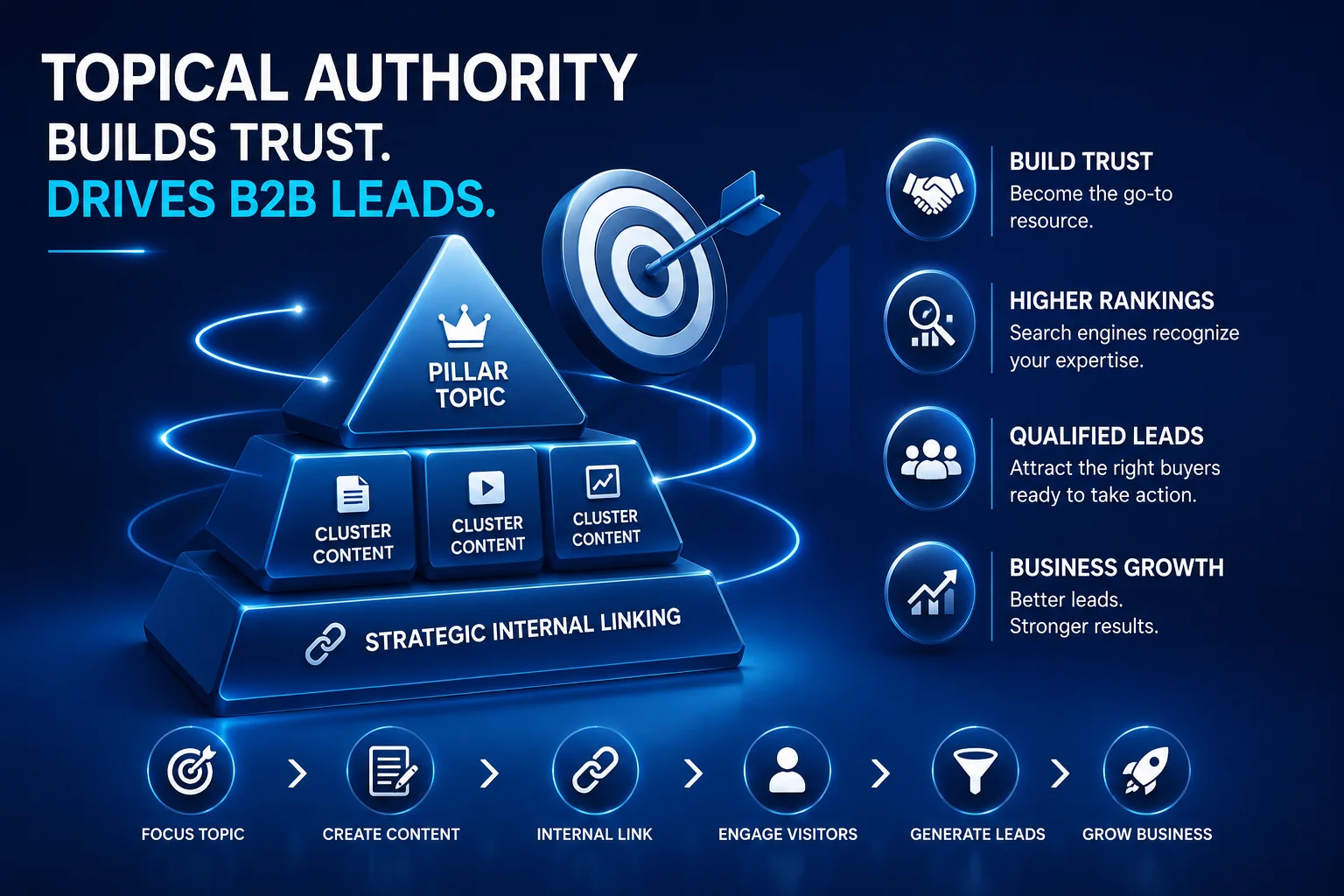
Building Topical Authority That Drives Qualified B2B Leads | Complete Guide
Learn how building topical authority helps improve SEO, build trust, and generate qualified B2B leads through a focused content strategy.
 search engine marketing
Search Campaign Optimization Best Practices
A well-built search campaign is only half the battle — ongoing optimization is what separates ads that merely run from ads that actually deliver consistent returns. Here are the best practices that keep your campaigns sharp, efficient, and continuously improving.