
Website Performance Optimization for Better User Experience
Introduction
A slow website doesn't just frustrate visitors — it quietly costs businesses revenue, rankings, and trust every single day. Studies have consistently shown that even a one-second delay in load time can significantly hurt conversions, and today's users have less patience than ever for sluggish pages. Website performance optimization isn't a technical nice-to-have anymore; it's a core part of user experience and business growth. This guide breaks down exactly how optimizing your website's performance leads to better user experience, stronger SEO, and higher conversions.
1. Page Speed Is the First Impression Your Website Makes
Before a visitor reads a single word of your content, they've already formed an opinion based on how fast your page loaded. A website that takes more than a few seconds to load creates an immediate sense of friction, and many visitors will simply leave before the page even finishes rendering.
This is especially critical for first-time visitors who have no existing trust or loyalty to your brand — a slow first impression often means they never come back to give you a second chance.
Key highlight: Page speed isn't just a technical metric — it's the very first piece of user experience your website delivers. Before design, content, or messaging even matter, speed determines whether visitors stick around long enough to see them.
2. Core Web Vitals Directly Influence Search Rankings
Google's Core Web Vitals — Largest Contentful Paint (LCP), Interaction to Next Paint (INP), and Cumulative Layout Shift (CLS) — are now official ranking factors. These metrics measure loading speed, interactivity, and visual stability, giving Google a concrete way to assess real-world user experience on your site.
Websites that fail to meet these thresholds don't just frustrate users — they actively lose visibility in search results, since Google increasingly favors sites that provide a smoother, faster experience over those that don't.
Key highlight: Performance optimization and SEO are no longer separate disciplines — they're deeply intertwined. A technically fast website is now a direct prerequisite for strong organic visibility, not just a bonus.
3. Image Optimization Delivers Some of the Fastest Wins
Images are often the single biggest contributor to slow page load times, yet they're also one of the easiest problems to fix. Compressing images, using modern formats like WebP or AVIF, and implementing lazy loading (so images only load as users scroll to them) can dramatically cut load times without sacrificing visual quality.
Many businesses are surprised to learn just how much unnecessary weight their websites are carrying simply because images were never properly optimized before being uploaded.
Key highlight: Image optimization is often the highest-impact, lowest-effort fix available. A few hours of image compression work can produce load time improvements that would otherwise require far more complex technical changes.
4. Mobile Performance Determines the Experience for Most Users
With the majority of web traffic now coming from mobile devices, mobile performance isn't a secondary consideration — it's often the primary one. Mobile users typically deal with slower network conditions and less powerful hardware than desktop users, which means performance issues that are barely noticeable on desktop can become major frustrations on mobile.
Google's mobile-first indexing also means the mobile version of your site is what primarily gets evaluated for search rankings, making mobile performance optimization essential rather than optional.
Key highlight: If your site performs well on desktop but poorly on mobile, most of your visitors are still having a bad experience. Mobile performance should be the baseline standard, not an afterthought layered on later.
5. Reducing Server Response Time Sets the Foundation
No amount of front-end optimization can fully compensate for a slow server response time. Time to First Byte (TTFB) — how quickly your server responds to a request — sets the floor for how fast your entire site can possibly load. Choosing quality hosting, using content delivery networks (CDNs) to serve content from locations closer to users, and optimizing backend database queries all contribute to faster server response times.
Businesses that invest heavily in front-end optimization while neglecting server performance often hit a ceiling on how much faster their site can actually get.
Key highlight: Front-end optimization can only go so far if the server itself is slow to respond. A fast, well-configured server is the foundation everything else builds on.
6. Minimizing Code Bloat Speeds Up Everything Downstream
Unused CSS, unoptimized JavaScript, and bloated code libraries silently slow down websites by forcing browsers to download, parse, and execute far more code than is actually necessary. Techniques like code minification, removing unused libraries, and splitting JavaScript so only what's needed loads first can significantly reduce this overhead.
This kind of technical cleanup often goes unnoticed by site owners because it doesn't show up visually — but its impact on load time and interactivity is substantial.
Key highlight: The code users never see is often what's slowing down the experience they do see. Cleaning up bloated, unnecessary code is one of the most impactful — and most overlooked — performance improvements available.
7. Caching Strategies Dramatically Improve Repeat Visits
Effective caching allows returning visitors to load pages significantly faster by storing certain elements of the site locally in their browser, rather than re-downloading everything on every visit. Browser caching, server-side caching, and CDN caching all work together to reduce redundant data transfer for users who've already visited your site before.
For businesses with high repeat traffic — like e-commerce stores or content-heavy sites — proper caching can be one of the most impactful performance improvements available, since it directly benefits your most engaged, returning visitors.
Key highlight: A great website shouldn't feel slower every time someone forgets to bookmark it and comes back. Caching ensures your most loyal visitors get your fastest experience, not a repeated full-weight load.
8. Faster Websites Directly Increase Conversion Rates
Performance optimization isn't just a technical or SEO concern — it has a direct, measurable impact on revenue. Faster-loading pages consistently show higher conversion rates, lower bounce rates, and longer average session durations compared to slower pages, because users are far more likely to complete a purchase, sign-up, or inquiry when the experience feels smooth and responsive.
Every additional second of load time introduces another opportunity for a visitor to lose patience and abandon the process entirely — particularly during checkout or form submission flows where friction is most costly.
Key highlight: Every second of load time is directly tied to lost revenue, not just lost patience. Performance optimization should be viewed as a conversion rate optimization strategy, not just a technical maintenance task.
9. Visual Stability Prevents Frustrating User Errors
Cumulative Layout Shift (CLS) measures how much content unexpectedly shifts around while a page is loading — think of clicking a button only to have an ad load above it and push it down, causing you to accidentally click something else. This kind of instability is deeply frustrating for users and often leads to accidental clicks, form errors, or abandoned actions.
Reserving space for images, ads, and dynamically loaded content before it fully loads prevents this frustrating shifting and creates a much more predictable, trustworthy browsing experience.
Key highlight: A page that keeps moving under a user's cursor breaks trust just as much as a page that loads slowly. Visual stability is a quieter but equally important part of performance-driven user experience.
10. Continuous Monitoring Keeps Performance From Silently Degrading
Website performance isn't a one-time fix — it tends to degrade gradually as new features, plugins, images, and scripts get added over time without anyone actively monitoring their cumulative impact. Regular performance audits using tools that track Core Web Vitals and load time trends help businesses catch performance regressions before they become significant problems.
Without ongoing monitoring, many businesses only notice their site has become slow after it's already affected rankings or conversions — at which point far more work is needed to fix accumulated issues than would have been needed to prevent them.
Key highlight: Performance optimization isn't a project you finish — it's a habit you maintain. Regular monitoring catches small slowdowns before they compound into major user experience and ranking problems.
Final Thoughts: Treat Performance as a Core Experience, Not an Afterthought
Website performance sits at the intersection of design, development, SEO, and revenue — which is exactly why it deserves far more attention than it usually gets. Businesses that treat performance optimization as an ongoing priority rather than a one-time technical task consistently see the benefits reflected in their search rankings, user engagement, and conversion rates.
The good news is that meaningful performance improvements don't always require massive overhauls — often, the highest-impact fixes are the most overlooked ones: optimizing images, cleaning up bloated code, and choosing solid hosting infrastructure.
Quick action checklist for businesses:
Run a Core Web Vitals audit to identify your biggest performance bottlenecks
Compress and modernize image formats across the site
Test mobile performance separately from desktop — don't assume they match
Implement proper caching for returning visitors
Set up ongoing performance monitoring instead of one-time fixes
A fast, stable, responsive website isn't just a technical achievement — it's one of the clearest signals of respect for your users' time. And in a world where attention spans are shrinking and competition is one click away, that respect translates directly into better rankings, better engagement, and better business results.
Frequently Asked Questions
Related Articles
 Web Development
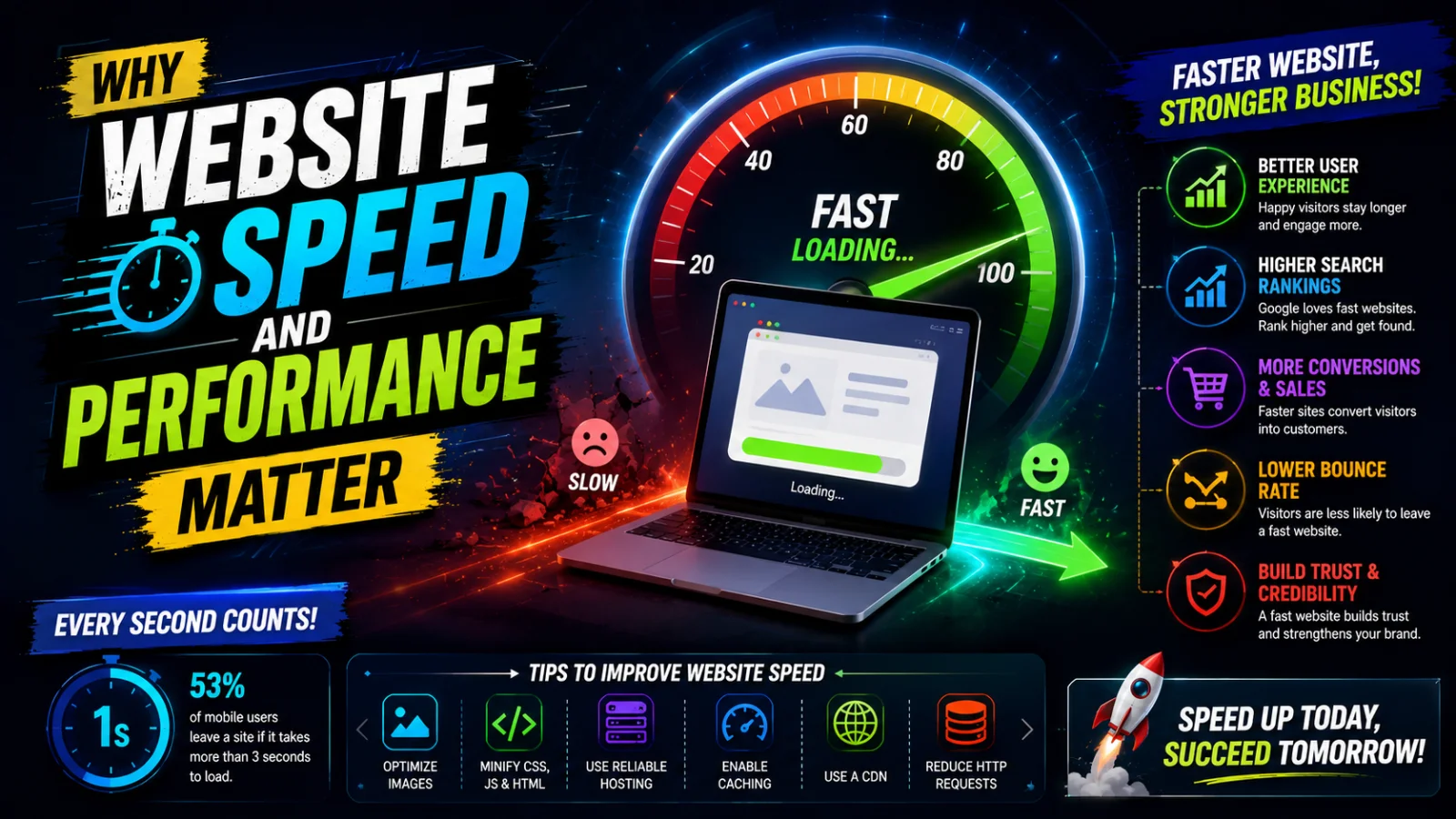
Why Website Speed and Performance Matter
Website speed and performance play an important role in user experience, SEO, and conversions. Learn how faster websites benefit businesses and how professional web development services can improve website performance.
 Web Development
Web Development Services for Small and Growing Businesses
Discover how professional web development services can help small and growing businesses build fast, responsive, secure, and SEO-friendly websites that attract customers and support long-term business growth.
 Web Development
High-Converting Business Websites That Generate More Enquiries
A high-converting business website is more than an attractive online presence—it is a powerful tool for generating enquiries and growing your business. By combining clear messaging, user-friendly design, strong calls to action, trust-building elements, and SEO-focused content, businesses can create websites that turn visitors into customers. Discover the key strategies to build a website that improves conversions and supports long-term business growth with insights from a top IT company in Salem, Tamil Nadu