
AI Chatbots That Improve Customer Support & Sales
Introduction
Every business today is racing to answer one question faster than the competition: how do you keep customers happy while also growing revenue, without hiring an army of people to do it? The answer, for a growing number of companies, is AI chatbots. What started as clunky, rule-based "type a keyword, get a canned reply" bots has evolved into sophisticated conversational systems powered by large language models, natural language processing, and machine learning. These modern chatbots don't just answer FAQs — they resolve complaints, recommend products, qualify leads, and even close sales, all while learning from every conversation they have.
In this blog, we'll walk through how AI chatbots are transforming customer support and sales, the real business benefits they bring, the technology behind them, and what to consider before adopting one for your own business.
Why Businesses Are Turning to AI Chatbots
Customer expectations have changed dramatically over the last decade. People want answers instantly, at any hour, on any channel — website, WhatsApp, Instagram, or a mobile app. Traditional support teams, no matter how skilled, simply cannot scale to meet that kind of round-the-clock demand without ballooning costs.
This is exactly the gap AI chatbots fill. They provide instant, consistent, and scalable responses to thousands of customers simultaneously. A single chatbot can handle the volume of dozens of human agents, and it never gets tired, never has a bad day, and never puts a customer on hold.
Beyond convenience, there's a strong business case too. Companies adopting AI-driven customer service tools consistently report lower support costs, higher customer satisfaction scores, and — perhaps most importantly for growth-focused teams — a measurable lift in sales conversions. Chatbots are no longer just a "nice to have" feature; they are becoming central to customer experience strategy.
How AI Chatbots Improve Customer Support
1. 24/7 Availability
Customers don't limit their questions to business hours. A shopper browsing at midnight or a user troubleshooting an issue over the weekend expects help right away. AI chatbots operate around the clock, ensuring no query goes unanswered simply because of the time on the clock. This alone can significantly reduce customer frustration and abandonment.
2. Instant Response Times
Long wait times are one of the biggest drivers of customer dissatisfaction. Chatbots eliminate the queue entirely — a customer types a question and gets an answer within seconds. For simple, repetitive queries like order status, refund policies, or account details, this instant response dramatically improves the customer experience.
3. Consistency in Answers
Human agents, even well-trained ones, can give slightly different answers to the same question depending on mood, experience, or interpretation. AI chatbots deliver consistent, accurate, on-brand responses every single time, which builds trust and reduces confusion.
4. Handling Repetitive Queries at Scale
A huge portion of support tickets are repetitive — password resets, shipping updates, return policies, and basic troubleshooting. By automating these routine queries, chatbots free up human agents to focus on complex, high-value, emotionally sensitive issues that genuinely need a human touch. This division of labor improves overall service quality.
5. Multilingual Support
Modern AI chatbots, especially those built on large language models, can converse fluently in multiple languages. This allows businesses to serve global or multilingual customer bases without hiring separate language-specific support teams for every region.
6. Seamless Escalation to Human Agents
The best chatbot implementations know their limits. When a conversation gets too complex, emotionally charged, or requires human judgment, a well-designed chatbot smoothly hands off the conversation to a live agent — along with full context of what's already been discussed, so the customer never has to repeat themselves.
How AI Chatbots Drive Sales
Customer support was the first major use case for chatbots, but sales is where the technology is proving to be a genuine growth engine.
1. Lead Qualification
Instead of a generic contact form that a sales rep has to manually sift through, chatbots can engage visitors in real time, ask qualifying questions, and identify which leads are sales-ready. This means sales teams spend their time on prospects who are actually likely to convert, rather than chasing cold leads.
2. Personalized Product Recommendations
By analyzing browsing behavior, purchase history, and stated preferences during a conversation, AI chatbots can suggest products tailored to each individual shopper — much like a knowledgeable in-store salesperson would. This kind of personalization has been shown to increase average order value and conversion rates.
3. Reducing Cart Abandonment
Online shoppers abandon carts for all sorts of reasons — hesitation about shipping costs, uncertainty about sizing, or simply getting distracted. A chatbot that proactively engages a hesitant shopper, answers last-minute questions, or offers a small incentive at the right moment can recover sales that would otherwise be lost.
4. Guiding Customers Through the Sales Funnel
From the first "hello" to the final "add to cart," chatbots can guide a visitor through the entire buying journey — answering product questions, comparing options, and nudging them toward a decision. This reduces friction and shortens the sales cycle.
5. Upselling and Cross-Selling
Well-trained chatbots can identify natural opportunities to suggest complementary products or premium upgrades, much like a skilled retail associate. Done tactfully, this increases revenue per customer without feeling pushy.
6. Round-the-Clock Sales Coverage
Just as chatbots never sleep for support, they never sleep for sales either. A visitor in a different time zone browsing at 3 AM can still get their questions answered and complete a purchase, something a human sales team simply cannot guarantee without significant staffing costs.
The Technology Behind Modern AI Chatbots
Today's leading chatbots are built on large language models (LLMs) that understand context, nuance, and intent far better than the old rule-based systems. Key technologies driving this shift include:
- Natural Language Processing (NLP): Allows chatbots to understand what customers actually mean, not just match keywords.
- Natural Language Generation (NLG): Enables chatbots to respond in natural, human-like sentences rather than robotic scripts.
- Machine Learning: Lets chatbots improve over time by learning from past conversations and outcomes.
- Integration with CRM and Support Systems: Modern chatbots connect directly with tools like CRMs, helpdesk software, and inventory systems, so they can pull real order data, check stock levels, or update customer records in real time.
- Sentiment Analysis: Helps chatbots detect frustration or urgency in a customer's tone and adjust their response — or escalate to a human — accordingly.
Real-World Impact
Businesses across industries — e-commerce, banking, telecom, healthcare, travel — have adopted AI chatbots with measurable results. Common outcomes reported by companies after implementation include:
- Significant reduction in average response time
- Lower cost per customer interaction compared to human-only support
- Higher first-contact resolution rates for routine queries
- Increased lead capture and qualification rates
- Noticeable uplift in conversion rates from chatbot-assisted sales conversations
While exact numbers vary by industry and implementation quality, the overall trend is clear: businesses that thoughtfully deploy AI chatbots see both cost savings and revenue growth.
Best Practices for Implementing an AI Chatbot
If you're considering adding a chatbot to your business, keep these principles in mind:
- Start with clear goals. Decide whether your primary objective is reducing support costs, improving response times, generating leads, or driving sales — this shapes how you design and train the bot.
- Design for smooth human handoff. No chatbot should trap a frustrated customer in an endless loop. Always provide an easy path to a human agent.
- Train on real data. The more your chatbot is trained on your actual product catalog, FAQs, and past support conversations, the more accurate and helpful it will be.
- Keep the tone on-brand. A chatbot is often a customer's first impression of your brand voice — make sure its tone matches your company's personality.
- Monitor and iterate. Treat your chatbot as a living product. Regularly review conversation logs, identify gaps, and retrain it to handle new types of queries.
- Be transparent. Let customers know they're talking to an AI, and make it easy for them to reach a human if they prefer.
Challenges to Keep in Mind
AI chatbots aren't a magic fix. Poorly designed bots can frustrate customers if they misunderstand queries, get stuck in loops, or lack the empathy needed for sensitive situations like complaints or refunds. Data privacy is another important consideration, especially when chatbots handle personal or payment information — businesses need to ensure compliance with relevant data protection regulations. Finally, over-automation can backfire; customers should never feel like they're fighting a machine to get simple help.
The businesses that succeed with chatbots are the ones that treat them as a complement to human support and sales teams, not a full replacement.
Conclusion
AI chatbots have moved far beyond their early reputation as clunky, frustrating "press 1 for support" digital assistants. Today, they are powerful tools that can operate 24/7, resolve customer issues instantly, qualify and nurture sales leads, personalize recommendations, and recover lost revenue — all while reducing operational costs. For businesses looking to improve both customer satisfaction and their bottom line, a well-designed AI chatbot isn't just a trend to watch; it's rapidly becoming an essential part of doing business in a digital-first world.
The key to success lies not in simply installing a chatbot, but in thoughtfully designing it around real customer needs, training it on accurate data, and continuously refining it based on real conversations. Done right, AI chatbots don't just support your customers — they become a genuine growth engine for your business.
Frequently Asked Questions
Related Articles
 AI Chatbot
WhatsApp Chatbot Implementation Best Practices: The Complete 2026 Guide to Automating Customer Engagement
Discover the top 10 WhatsApp chatbot implementation best practices for 2026. Learn how to automate customer support, boost engagement, and grow your business with expert tips from JHB Automations
 AI Chatbot
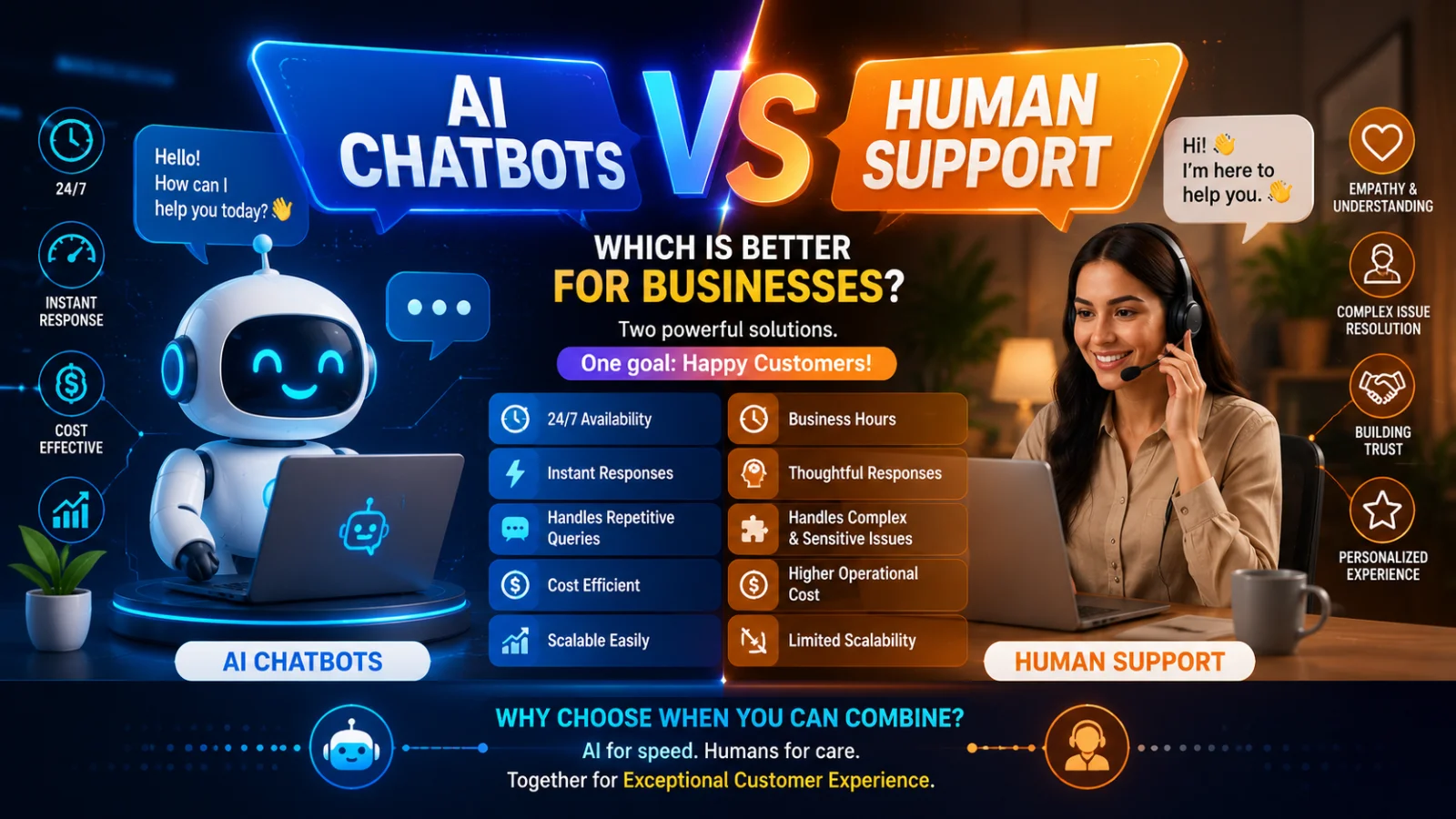
AI Chatbots vs Human Support: Which Customer Support Strategy Delivers Better Business Results?
Choosing between AI chatbots and human support impacts your costs, response time, and customer retention. Here's a complete comparison to help you pick the right strategy for your business.
 E-commerce website
The Future of Mobile Commerce and E-commerce Website Development
Mobile commerce growth, AI-driven personalization, headless architecture, voice commerce, PWA, social commerce, AR/VR, and sustainability are the key trends shaping e-commerce websites in 2026.